Episode 2 (Angie's List): storyboard · teleprompter
Open the editor storyboard → Every line of the script with its picture, text on screen and sound effect, plus all pictures to download.
Open the teleprompter → Clean script, no notes, with start/pause and speed.
Deal Autopsy: a weekly acquisition story video
Working name only. Ray William Johnson's method, with one thing he doesn't have: a buyer's view of the deal.
What Ray's videos actually do
Measured on his last 400 uploads and 4 transcripts (saved in the private research folder).
| What | Number or pattern |
|---|---|
| Length | About 9 minutes, about 1,460 words, almost the same every time |
| Typical long video | 479,000 views (median) |
| His business videos | 950,000 to 2.3M views (LifeLock 952K, ZZZZ Best 980K, "Biggest Scam" 1.05M, Don Lapre 2.3M) |
| First sentence | Gives away the ending: "this CEO's marketing stunt is about to go horribly wrong" |
| Second sentence | First name, age, place, what he wants |
| Tense | Present tense, so it feels like it is happening now |
| Language | About 15 words a sentence, short words, "So", "But then" |
| Title | 3 to 7 words. Usually no company name |
| Twists | A new turn about every 50 seconds |
| Ending | One dry line. No pitch |
Warning from the data: his newest long videos get only 200,000 to 330,000. His last 60 Shorts have a median of 294,000, so long videos are not losing to Shorts. Cutting 3 to 5 Shorts from each episode is optional.
Ray's business videos
Links go to his own channel. The Instagram reel is here too.
 He Made The Biggest Marketing Stunt Fail in HistoryLifeLock · 952K views
 This CEO Finally Got CaughtZZZZ Best · 980K views
 The Biggest Scam in HistoryScam story · 1.05M views
 Don Lapre: the greatest con man in TV historyDon Lapre · 2.3M views
 He Stole $3 Billion: the Jimmy Zhong storyJimmy Zhong · 1.5M views
 Dane Cook Lost MillionsDane Cook · 969K views
 The Eric Adams story (YouTube twin of the reel)Eric Adams · 1.42M views
The downloaded videos and full transcripts are not on this page because they are Ray's copyrighted work. They stay in the private research folder on Moran's Mac.
Instagram vs YouTube: it is the same video
Compared the reel Moran sent with its YouTube twin, the Eric Adams story.
| Instagram reel | YouTube | |
|---|---|---|
| Length | 8:01 | 8:03 |
| Shape | Vertical 9:16 | Vertical 9:16 |
| Picture at 2:00 | Same frame | Same frame |
| Numbers | 244,924 likes (views hidden when logged out) | 1.42M views |
| Posted | 6 Jan 2025 | Not checked |
He doesn't make short cuts for Instagram. He posts one vertical 8-minute video in both places, with a purple progress bar burned into the bottom. All 4 business videos downloaded are vertical too. Only his separate 1-minute Shorts are different pieces.
What this means for us: one vertical 8 to 9 minute master, the same file on YouTube, Instagram, TikTok and Facebook. No landscape version. Clips are a bonus.
Correction: the first version of this page called it a plain selfie take. It isn't. See the editor brief.
What is on screen
I sampled a frame every 15 seconds from 2 business videos (72 frames in all).
| On screen | Share of frames |
|---|---|
| AI comic-style pictures of the story | About 60% |
| Ray talking to camera at his desk | About 30% |
| Black cards and real clips | About 10% |
The format
| Time | Part | Source |
|---|---|---|
| 0:00 | Ending first, in one line | Filing |
| 0:15 | The person and what they want | Filing, press |
| 1:00 | How the deal was found | SEC proxy |
| 2:30 | The negotiation, offer by offer | SEC proxy |
| 4:30 | The structure: cash, stock, debt, fees | SEC proxy |
| 5:30 | What went wrong or right after closing | Annual reports |
| 7:00 | Moran's whiteboard: the math, what he would have done | Your expertise |
| 8:30 | How a small buyer copies it, where AI goes | Your expertise |
| 9:00 | One dry last line |
You often don't need to guess. Every US public merger files a section called "Background of the Merger". It gives the dates, who called whom, each offer and who walked away. Almost nobody on YouTube reads it. That is the moat, and it is free.
Three rules
- Say which of three things each claim is: "this is filed", "this is my read", or "this is my math". A small on-screen tag works. Your guesses become the proof that you are the expert, and they stay honest.
- It sounds like your case study, but it never says it is. Say "here's what I'd have done", never "we" about their deal. Viewers will check, and one false "we" costs more than the video earns.
- No "you should buy this stock". The videos teach how deals work. Stick to the facts allowed in our truth document, and have a lawyer read the first one.
Choosing deals
Pick by story first, deal size second. The best ones have a named person, a failed attempt, a rival bidder or an ugly integration. Public deals only at first, because they come with filings. Sample picks: Rentokil–Terminix, Waste Management's founders, Comfort Systems' 12 founders, Salesforce–Slack, Bending Spoons.
Keep the company name out of the title and the thumbnail, as Ray does. Hold your own deals back too, until you have a closed deal you can show.
Sample episode: Rentokil buys Terminix (version 3)
Version 3 has the numbers fast, your authority line, your two cents in the middle of the story, and four lessons at the end: for the owner who wants an empire, for the advisor, for the investor, and for AI after the deal. About 2,650 spoken words, so about 16 minutes at Ray's speed, plus pictures and pauses.
Tags are for the editor: [PIC] comic picture, [DATA] real screenshot or number card, [MORAN] on camera, [SFX] sound, [2¢] Moran steps out of the story for a short lesson, then jumps back in.
Title and how to say the names
| Title (pick) | 3 Years Of Waiting To Buy A $6.7 Billion Rival |
| Backup titles | "He Paid $6.7 Billion To Kill Bugs" · "Why A British Company Paid $6.7 Billion For Termites" · "He Turned One Phone Call Into A $6.7 Billion Deal" |
| Thumbnail | Moran's shocked face, a cartoon bug, "$6.7 BILLION" in green |
| Rentokil | RENT-oh-kill. Like "rent" + "oh" + "kill". It is British. |
| Terminix | TER-mih-nicks. Like "terminate" + "nix". It is American, the one with the trucks. |
| Andy Ransom | ANN-dee RAN-sum. Rentokil's CEO, the buyer |
| Lazard | luh-ZARD. The bankers Terminix hired |
| Nelson Peltz | NEL-sun PELTS |
Who is who, so you never mix them up: Rentokil is the buyer (British, Andy). Terminix is the one being bought (American, trucks).
The script
[PIC 1] [SFX cash] So this CEO is about to spend six point seven billion dollars on bugs. And it's about to go very, very wrong.
[PIC 2] Now the CEO, his name's Andy. And Andy runs a British company called Rentokil. Rent-oh-kill. Fun fact, the guy who started it in 1925 wanted to call it "Entokil", from the Greek word for insect. Somebody already had that name. So he just stuck an R on the front. Rentokil.
[PIC 3] And what do they do? They kill bugs. Rats, roaches, termites. You call them, a guy shows up in a van, the bugs go away. That's the whole business.
[PIC 4] And all Andy wants is America. Because America is the biggest bug-killing market in the world. And Andy is not winning it.
[DATA 1] Because the company in his way is the American one. Terminix. Ter-mih-nicks. You've probably seen their trucks. Almost three million customers.
[MORAN] And here's why you should care. This story has a six point seven billion dollar price tag, a CEO who waits three years, a fight over one single dollar that's worth a hundred and twenty million, a twelve million dollar golden parachute, and a stock that crashes twenty percent in one day. And by the end, I'll show you how the exact same playbook works if you buy one little bug company in your town.
[MORAN, authority] Oh, and if we haven't met, my name is Moran Pober. I'm the founder of Acquisitions.com, and I built and sold Rollups.com. I was involved in a roll-up that went from zero to 200 million dollars in revenue in under a year. And now I run Acquisitions.com, which has been involved in more than a billion dollars' worth of transactions. Just check the website, you'll see. Okay. Back to Andy.
[PIC 5] So you'd think Andy goes after Terminix, right? Nope. It's actually the other way around.
[PIC 6] It's 2018, and Terminix reaches out to Andy first. They meet twice. They sign an NDA. Now, an NDA is just a promise on paper. It says: I'll show you my secrets, and you don't tell anybody. Totally normal before you talk about buying a company.
[PIC 7] [SFX record scratch] And then, by June, the whole thing dies. They can't agree on the price. Everybody goes home.
[MORAN] And most people would stop there. But here's the thing. Andy waits.
[MORAN, 2¢] And this is the first lesson, and it's the one nobody believes. Most deals die the first time. In small business, it's the same. The owner says "not now". The price is wrong. Somebody's not ready. The guys who win are the ones who stay in touch. So if an owner tells you no, that's not a no. That's a "call me in a year". Okay, back to Andy.
[PIC 8] So he waits three years. And while he's waiting, Terminix does something kind of crazy. It gets rid of everything that isn't killing bugs. It had a home warranty business. Gone. It had cleaning brands. Sold. So now Terminix is nothing but bugs. Which means it's now exactly the company Andy wants.
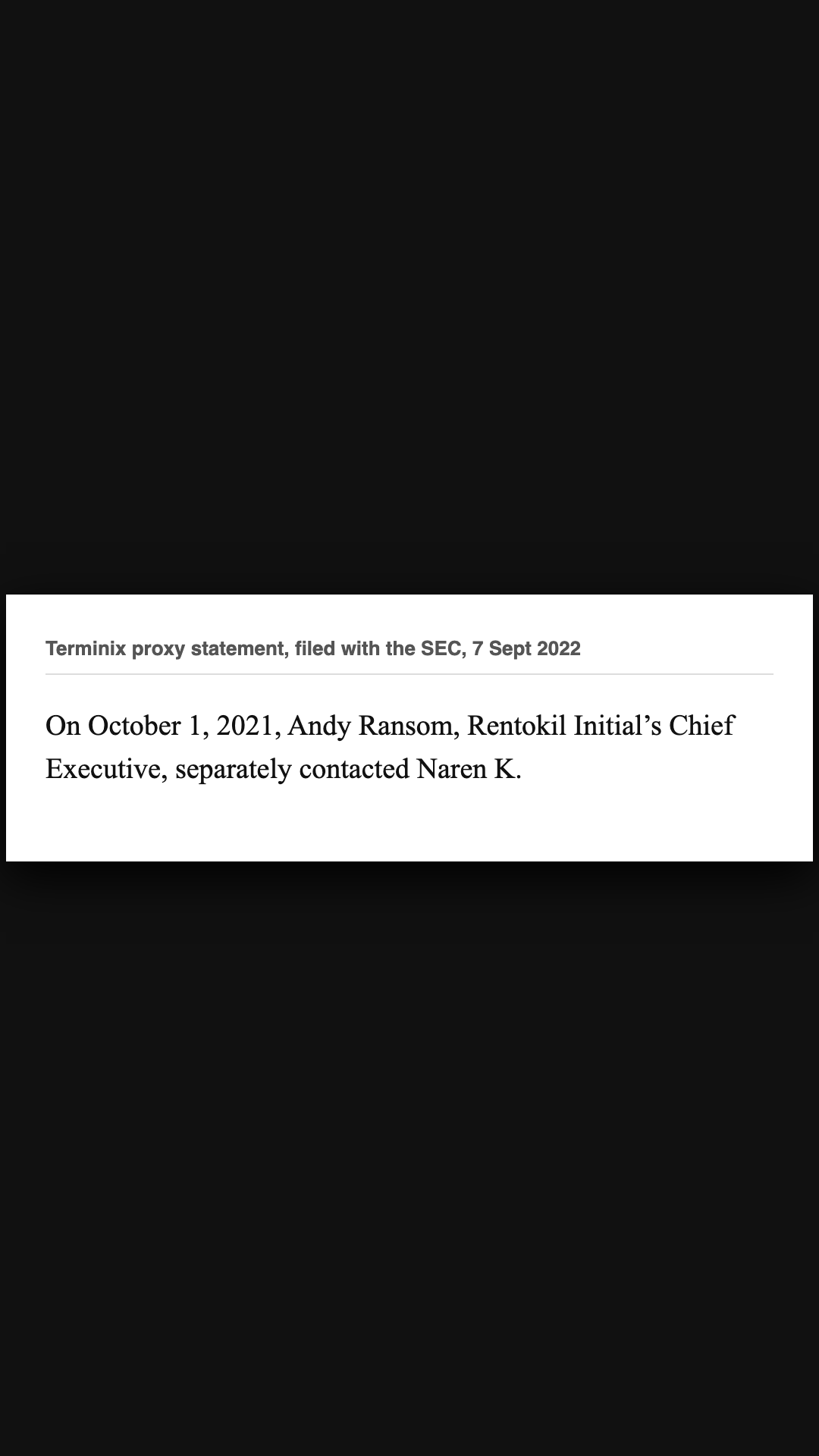
[PIC 9] [SFX phone ring] So on October 1st, 2021, Andy picks up the phone. And he doesn't call the CEO. He calls the chairman. The chairman runs the board, and the board is basically the CEO's boss. So Andy goes straight to the boss's boss.
Three days later, he calls the CEO.
[MORAN, 2¢] So how did he find the deal? Not from a listing. Not from a website. He knew the company, they'd already talked once, and he picked up the phone. And for a small business, it's honestly the same three ways. One, you call the owner directly. Two, you get to know the brokers who sell businesses like this. Three, you talk to the accountants and lawyers who know which owners are tired and ready to retire. That's where most deals come from. Okay, back to the phone call.
[PIC 10] Now, Terminix isn't stupid. They hire Lazard. Luh-zard. That's a Wall Street firm you pay to get you the highest price. And Lazard quietly goes shopping. They call one big competitor and two private equity firms. Private equity is basically a group of rich investors who buy whole companies, mostly with borrowed money. And the reason you call them is simple. If you want a better price, you need a second buyer.
[DATA 2] [MORAN, 2¢] And by the way, how much does Lazard get paid for this? It's right there in the paperwork. Forty-five million dollars. Five million up front, and the rest only if the deal closes. Now, forty-five million sounds insane, but on six point seven billion, that's less than one percent. On small deals, the slice is much bigger. A small business broker selling a company under a million dollars usually charges somewhere around eight to twelve percent of the price. On bigger deals, a lot of advisors use a sliding scale: five percent of the first million, four percent of the second, three of the third, and so on down. So the bigger the deal, the smaller the percentage, but the bigger the check. And if you're someone who knows owners and knows buyers, just think about that. And check the rules where you live before you take a fee for connecting a deal. Okay, back to the shopping.
[PIC 11] Then on October 29th, Andy walks into a meeting and he says the number. Fifty-four dollars a share. [SFX cash]
[MORAN] So what's a share? A company like Terminix is cut into millions of tiny pieces. Each piece is a share. If you own one, you own a tiny slice of the company. Terminix had about 120 million of them. So Andy is offering fifty-four bucks for every single slice.
And he doesn't want to pay it all in cash. Twenty percent cash. Eighty percent in Rentokil shares. So he's basically saying: I'll pay you mostly with pieces of my own company.
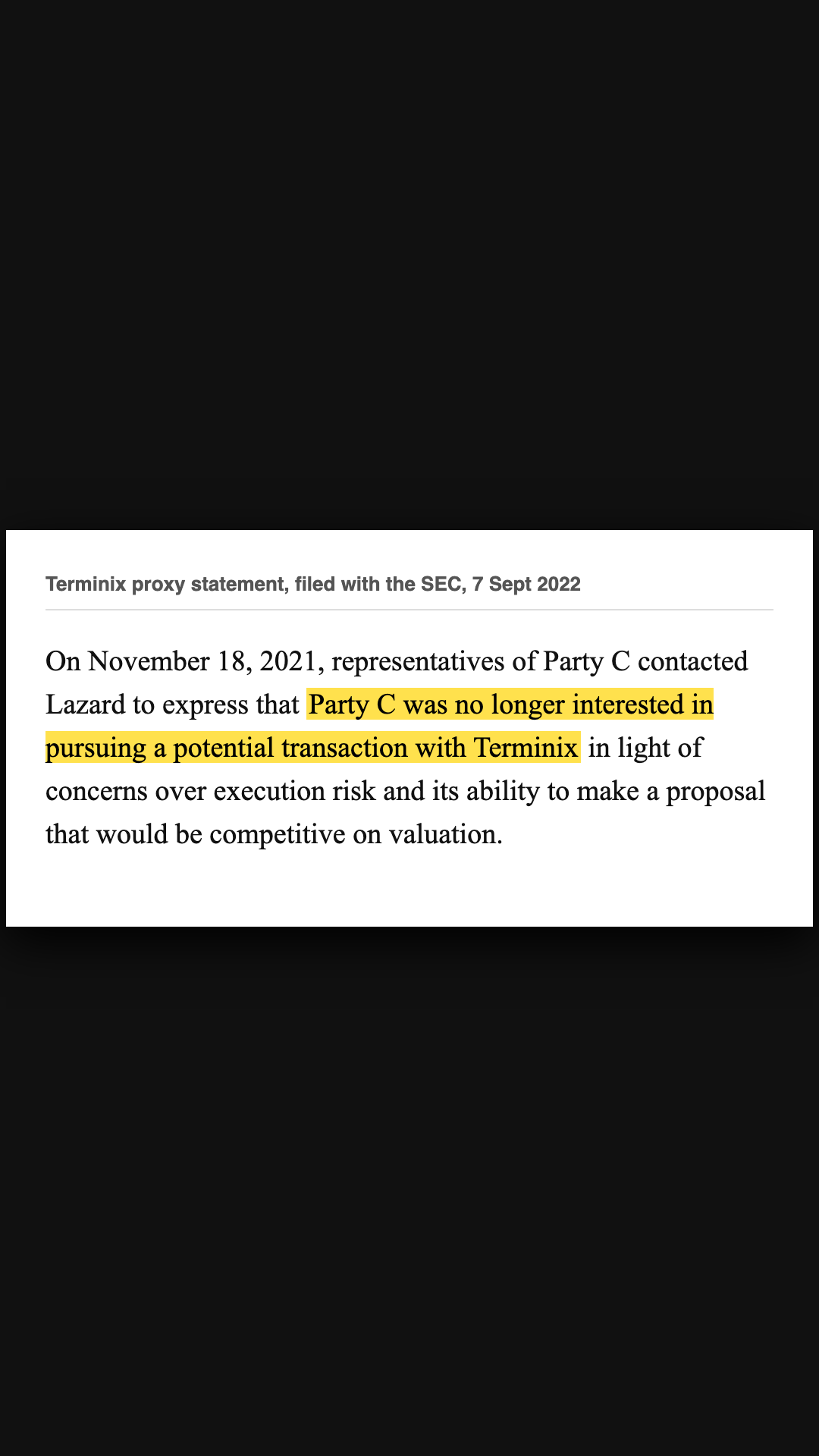
[PIC 12] [SFX phone ring x3] Then Terminix's phone starts ringing. And it's bad news. The first private equity firm says, we can't beat that price. The big competitor says, we'd never be able to swallow a company this size. And on November 18th, the last private equity firm walks away too.
[MORAN] So now Terminix has exactly one buyer. Andy. And as far as the paperwork shows, Andy has no idea. That's the whole game.
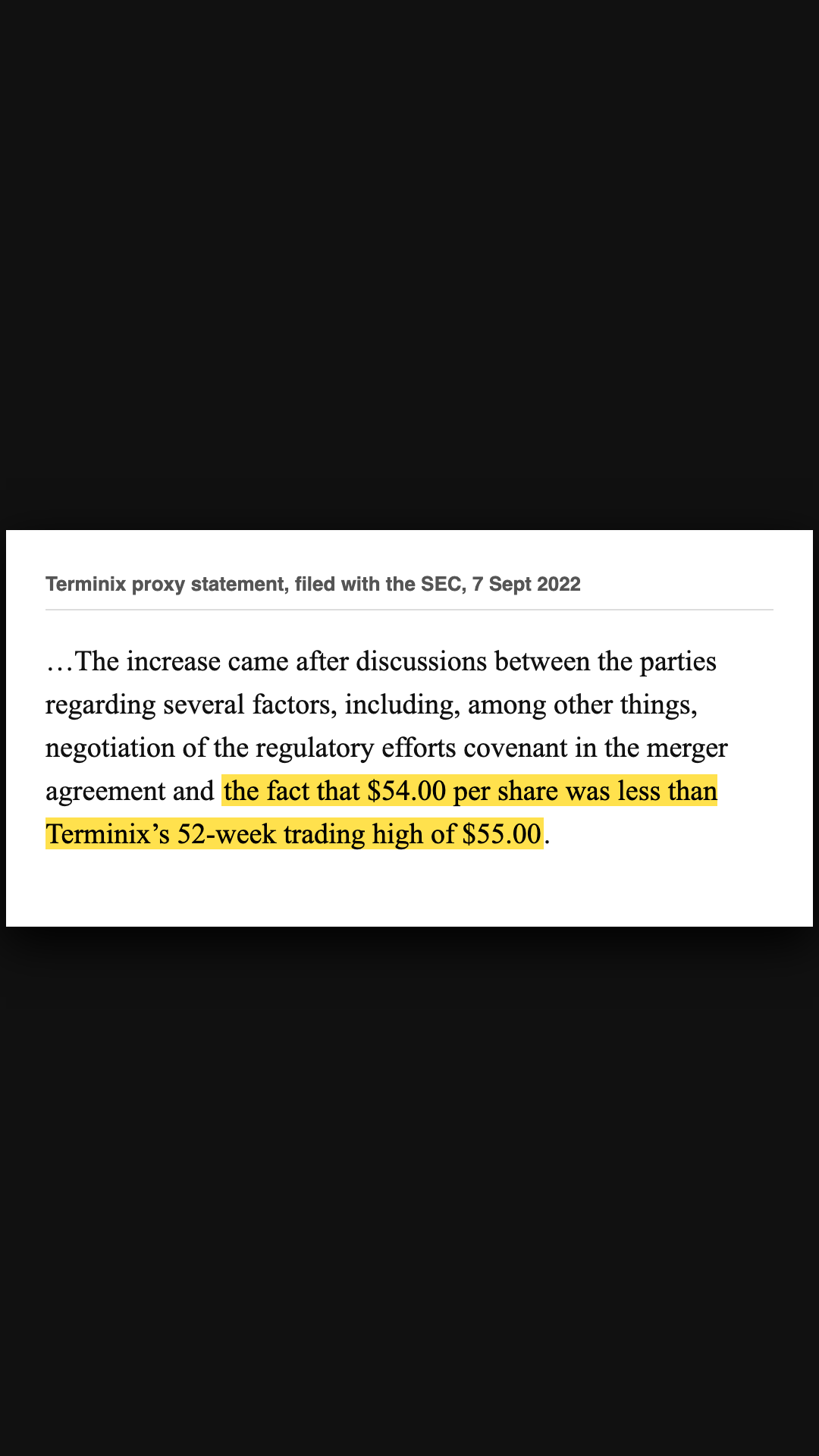
[DATA 3] So what does Terminix do? They push anyway. They look at their own stock chart and notice something. At one point that year, their share price hit fifty-five dollars. So they basically tell Andy: you're offering us less than our own stock was worth this year.
[PIC 13] [SFX coin drop] And Andy goes up one dollar. Fifty-five. Exactly that high. The whole price fight? One dollar. But one dollar times 120 million shares is about 120 million dollars. So yeah. That one dollar matters.
[MORAN, 2¢] And this is a trick you can use tomorrow. Terminix didn't argue about feelings. They pointed at one number the buyer couldn't argue with. In a small deal, that number might be what the business down the street sold for, or what a bank says it'll lend. Find the number they can't argue with. Okay. Back to the lawyers.
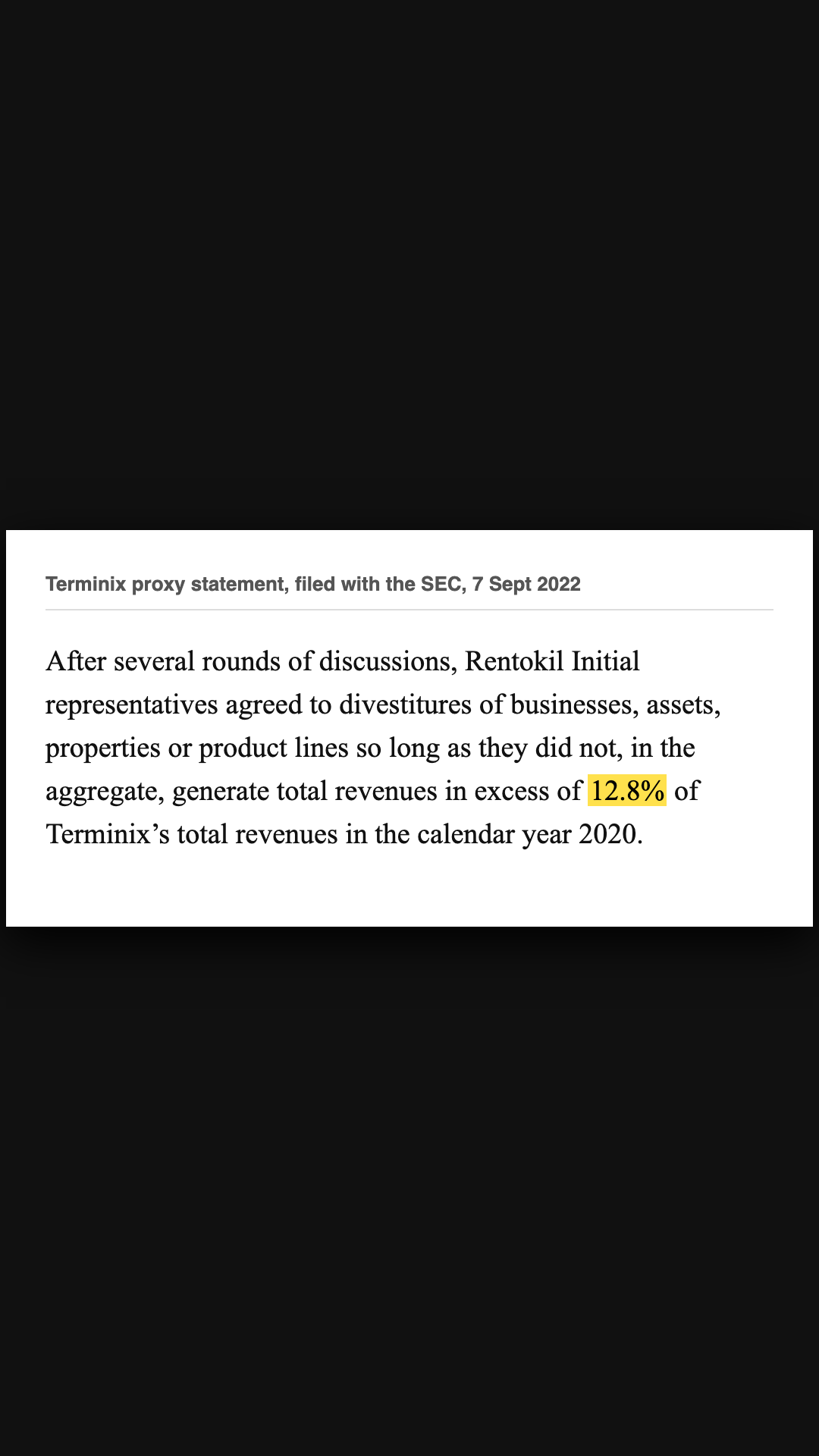
[PIC 14] [SFX thunder] Then the lawyers fight about the scariest three words in buying companies. Hell or high water. See, when two giant companies merge, the government checks the deal, to make sure one company doesn't end up owning the whole market and jacking up prices. And sometimes the government says: fine, but first you sell off some pieces. Terminix wants Andy to promise he'll do anything the government asks. No matter what. Hell or high water. Andy says no way. So they agree on a limit. He'll sell off pieces worth up to 12.8 percent of Terminix's sales. And not one penny more.
[DATA 4] And they agree on breakup fees too. If Terminix walks away for a better offer, it pays Andy two hundred million dollars. If the deal dies in certain ways on Andy's side, he pays a hundred and fifty million. So basically, both sides put money on the table to prove they're serious.
[DATA 5] [SFX cash] December 14th, 2021. The deal is announced. Fifty-five dollars a share is 47 percent more than the stock was worth the day before. So if you owned Terminix shares, you woke up and they were worth almost half again as much. All in, about six point seven billion dollars.
[DATA 6] And Terminix's CEO? The paperwork estimates that if he lost his job after the deal, he could walk away with about twelve point nine million dollars. That's called a golden parachute. Not bad for selling a bug company.
[PIC 15] [SFX cash] And Andy makes a promise. Once the two companies are merged, he'll save at least 150 million dollars a year. How? One headquarters instead of two. One computer system. And fewer branches covering the same streets.
The deal closes in October 2022. So Andy won. Right?
[PIC 16] Well. To get those savings, you have to actually merge everything. Two sets of offices. Two sets of routes. Two sets of trucks. So the guy who's been spraying your house for years, who knows your dog's name? He might not be the guy anymore.
[DATA 7] [SFX crash] And in October 2023, Rentokil warns investors that its American business is weaker than expected. And the stock drops. Then it warns again. And in September 2024, the shares drop as much as 20 percent in one day.
[PIC 17] And now a guy named Nelson Peltz is in the picture. Peltz is what they call an activist investor. He buys a big chunk of a company's stock, and then he pushes the bosses to fix things. And his firm gets a seat on Rentokil's board.
[DATA 8] [SFX record scratch] Oh, and fun fact. Nelson Peltz's daughter, Nicola, married Brooklyn Beckham in 2022. That's David Beckham's son. So the guy breathing down Andy's neck is David Beckham's in-law.
[PIC 18] And Andy? By the last report, Rentokil's plan keeps about 220 small local branches. Turns out the small guys had it right.
[MORAN, whiteboard] Okay. That's the story. Now let me show you what I actually see when I look at this deal. And I'll go slow, because this is the stuff nobody explains.
First word: EBITDA. Sounds scary. It's not. EBITDA is basically the profit a business makes from doing its job, before it pays interest on its loans, before taxes, and before some accounting stuff. Think of it as: how much cash does this machine spit out every year?
[DATA 9] Terminix made about 345 million dollars of EBITDA in a year. Andy paid 6.7 billion for the shares. Divide one by the other, and you get more than 19. So Andy paid more than 19 years of profit. That's called the multiple. It just means: how many years of profit am I paying for? And that's before Terminix's own loans, which Andy took over too.
Is 19 expensive? For a small bug company, insanely expensive. But here's what Andy's counting on. Add his 150 million of savings to the 345, and the business now makes about 495 million. Divide 6.7 billion by that, and it's about thirteen and a half. So he didn't really buy a company. He bought a savings plan. If the savings show up, the price was fair. If they don't, he overpaid.
Second word: debt. Rentokil lined up a bank loan of up to 2.7 billion dollars to pay the cash part and pay off Terminix's old loans. Every year you pay interest on a loan. That yearly payment is called debt service. I don't know the exact rate they got, so this is my guess. If it was 5 percent, that's about 135 million dollars a year, just in interest, before you've saved one dollar. So those savings aren't a bonus. They're how you pay the bank.
[MORAN] Now here's where it gets fun. Because there are four kinds of people watching this, and each one should learn something different.
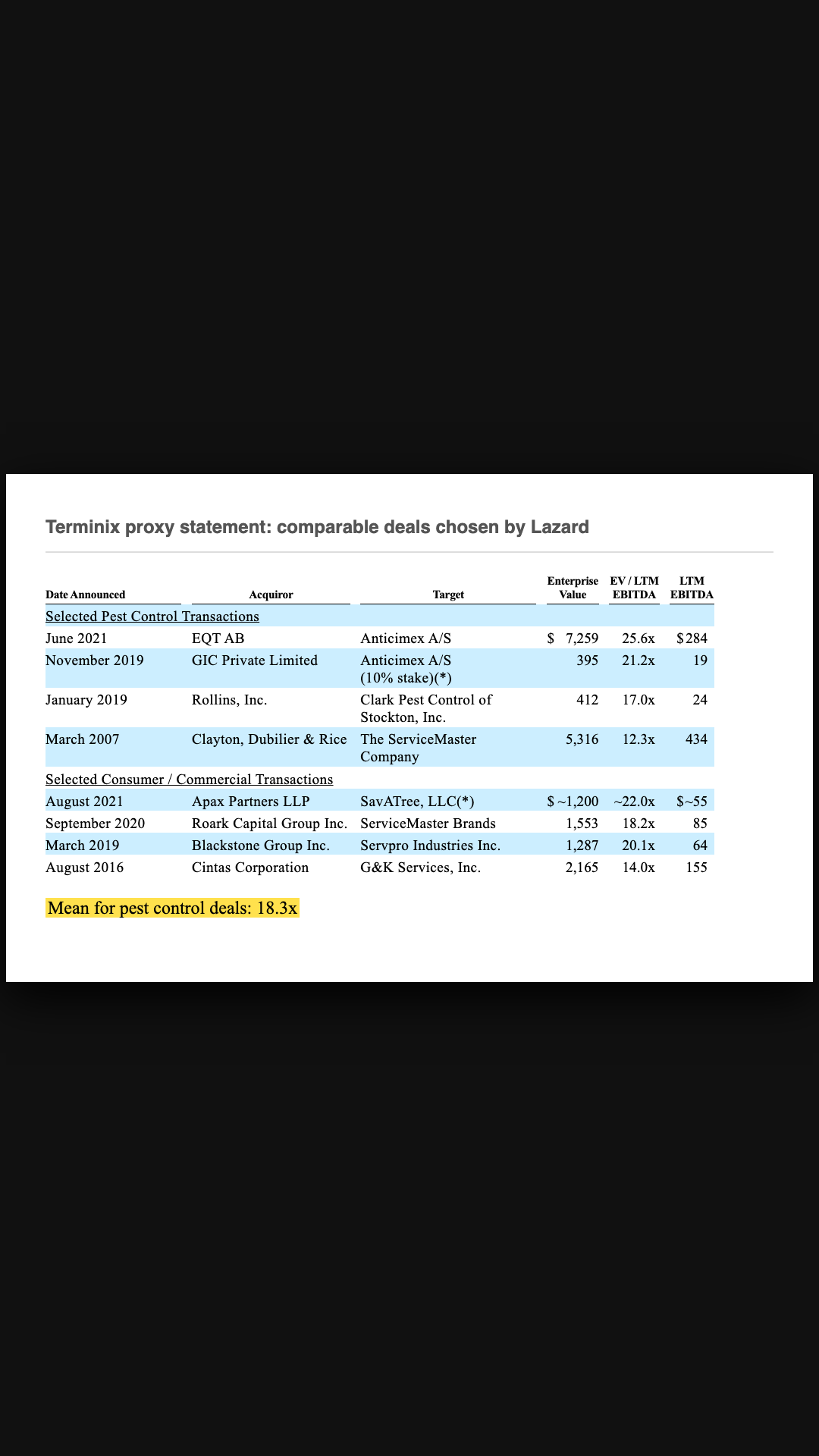
[DATA 10] [MORAN, lesson 1: if you want to build an empire] If you own a small business, or you want to buy one, look at this ladder. All real numbers. In 2025, Rentokil bought 36 small bug companies. Together they had 63 million dollars of sales, and Rentokil paid 115 million. Less than two dollars for every dollar of sales. Small companies sell cheap. One step up: in 2019, Rollins, another giant, bought Clark Pest Control, which made about 24 million of EBITDA a year. They paid 17 times that. And at the top, Andy paid more than 19 times for Terminix.
So the same dollar of profit is worth a little when you're small and a lot when you're big. That's the whole roll-up game. You buy one small pest control company. Then you buy the next one in the next town, and the next. Every one you add, the whole thing gets worth more per dollar of profit. And one day, either you're the one buying hundreds of them, or you're the one getting the phone call from someone like Andy.
And how do people buy that first one? Usually not with all their own money. In the US, a lot of small businesses are bought with an SBA-backed bank loan, often with around ten percent down, and sometimes the seller lets you pay part of the price over a few years. That's called a seller note.
[MORAN, lesson 2: if you want to be the connector] If you're the person who knows owners, or knows buyers, this is your lesson. Remember Lazard's forty-five million. Every deal has someone in the middle who found it, set it up, or pushed the price up. On a small deal, that's a broker or an advisor, and it pays. So in your town, who owns the bug company? Who owns the HVAC company? Who's tired and wants out? If you know that, you're worth a lot to someone like Andy.
[DATA 11] [MORAN, lesson 3: if you want to invest] If you're an investor, look at who actually made money here. Terminix shareholders got 47 percent more than the day before, in a few weeks. They won. Rentokil's shares were about 627 pence when the deal was agreed, and in 2026 they've been trading around 430 to 450. That's roughly a third lower.
So the lesson is simple. When a big company buys, the seller usually wins on day one. The buyer only wins if the merge works, and that takes years. The risk isn't the price. The risk is the integration. So when you invest in a roll-up, don't ask "how many companies did you buy?" Ask "show me one you already merged, and what happened to the customers."
And this is exactly how the new AI investors think. Firms like General Catalyst and Thrive Capital are putting money into what people call AI roll-ups. Instead of a tech startup, they back a team that buys boring service businesses, then runs them on AI. General Catalyst says one of these, Long Lake, has bought 18 businesses. Their bet is simple: buy the business at a normal price, then use software to make it run with fewer mistakes and less paperwork.
[MORAN, lesson 4: what I'd do after closing, with AI] And that's where I'd do this deal differently. Look at Terminix's own estimate of the savings. About 108 million was the office side. Billing, admin, the people doing paperwork. About 45 million was branches and routes. About 21 million was buying, marketing and the call center. Guess which part AI is really good at? The office. Answering calls, booking appointments, sending invoices, chasing late payments, planning routes. That's where I'd start, on day one.
But I'd leave the technicians and the routes alone until the numbers prove it's safe. Because the customer doesn't care about your savings plan. The customer cares who shows up at the door.
[MORAN] So that's the deal. A bug company, a three-year wait, a one-dollar fight, and a stock that's still trying to get back. If you want to build something like this, start with one small company and do the merge right. And if you want me to break down another deal like this, tell me which one in the comments.
[PIC 19] [cut to black, no sound] And Andy? Still killing bugs.
Words explained in the script
| Word | Plain meaning used |
|---|---|
| NDA | A written promise not to share the other side's secrets |
| Chairman, board | The board is the CEO's boss. The chairman runs the board |
| Private equity | Rich investors who buy whole companies, mostly with borrowed money |
| Share | One tiny slice of a company |
| 52-week high | The highest price the stock hit in the last year |
| Premium (47%) | How much more than yesterday's price the buyer pays |
| Hell or high water | A promise to do anything the government asks to get the deal approved |
| Savings (synergies) | Money saved by merging: one office, one system, fewer branches |
| Activist investor | Buys a big piece of a company, then pushes the bosses to change |
| EBITDA | Profit from doing the job, before loan interest, taxes and accounting items |
| Multiple | How many years of profit you pay |
| Golden parachute | Money a CEO gets if he loses his job after a sale |
| Breakup fee | Money one side pays the other if the deal dies in certain ways |
| Seller note | The seller lets you pay part of the price over a few years |
| SBA loan | A US bank loan partly backed by the government, common for small business purchases |
| Debt service | The yearly payment on a loan |
| Roll-up | Buy many small companies cheap, and the market values them at the big company's price |
Shot list for the editor
| # | Type | What is on screen |
|---|---|---|
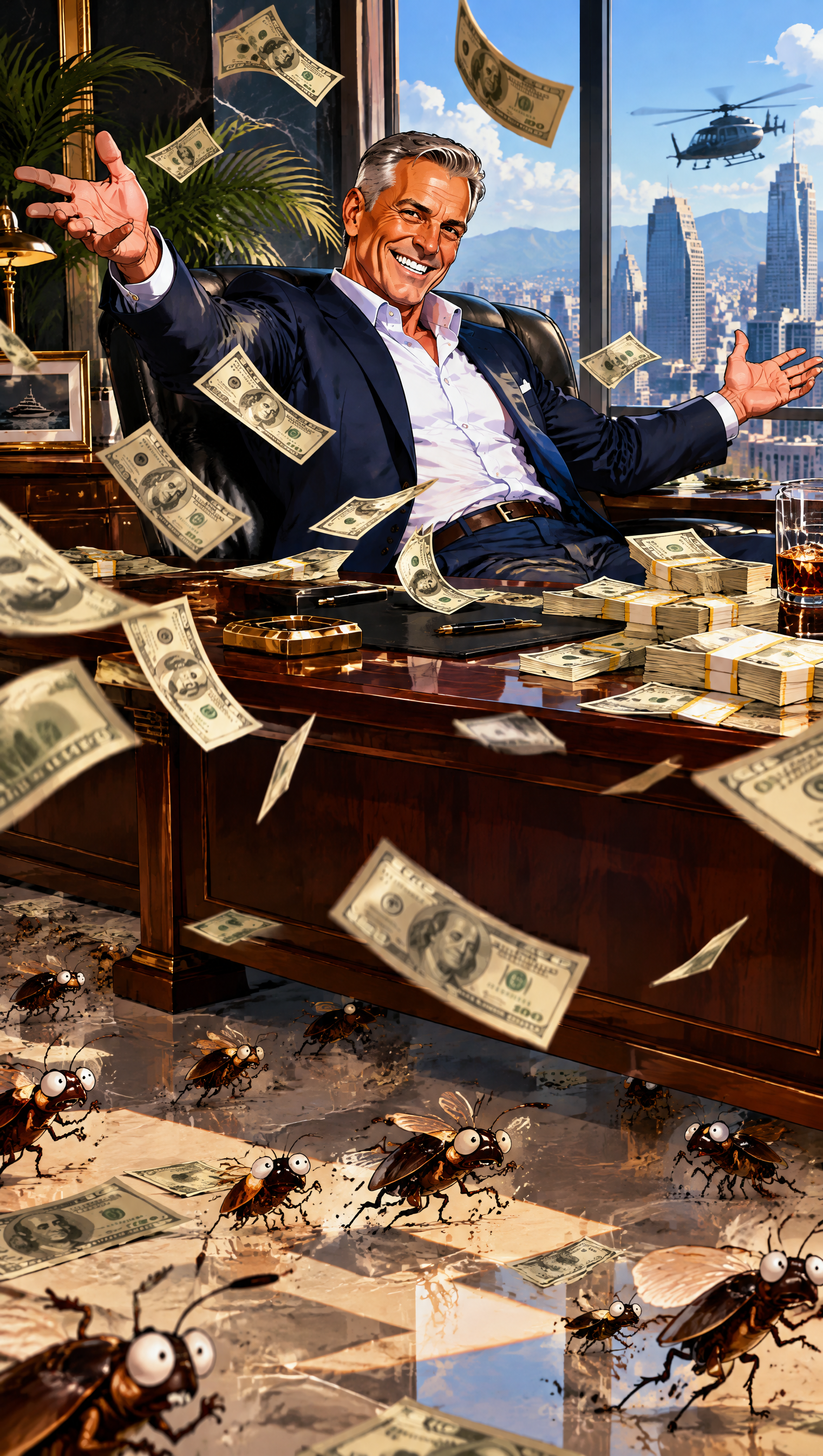
| PIC 1 | Comic | Andy grinning, money flying off a desk, cartoon bugs everywhere. "ANDY" label with purple arrow |
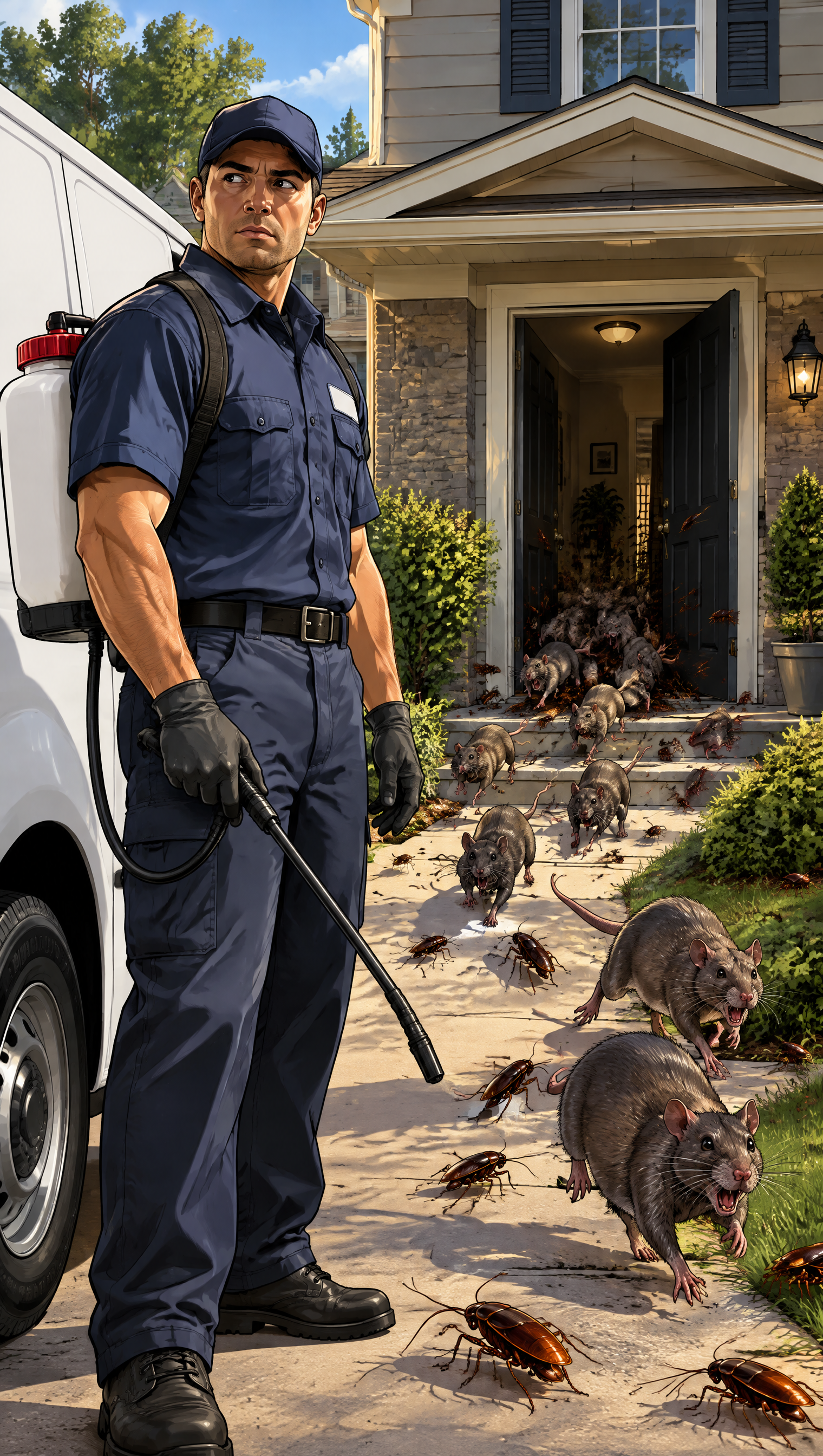
| PIC 2 | Comic | Rentokil technician in a van at a house, rats and roaches running out |
| PIC 3 | Comic | Andy looking hungrily at a US map covered in little bugs |
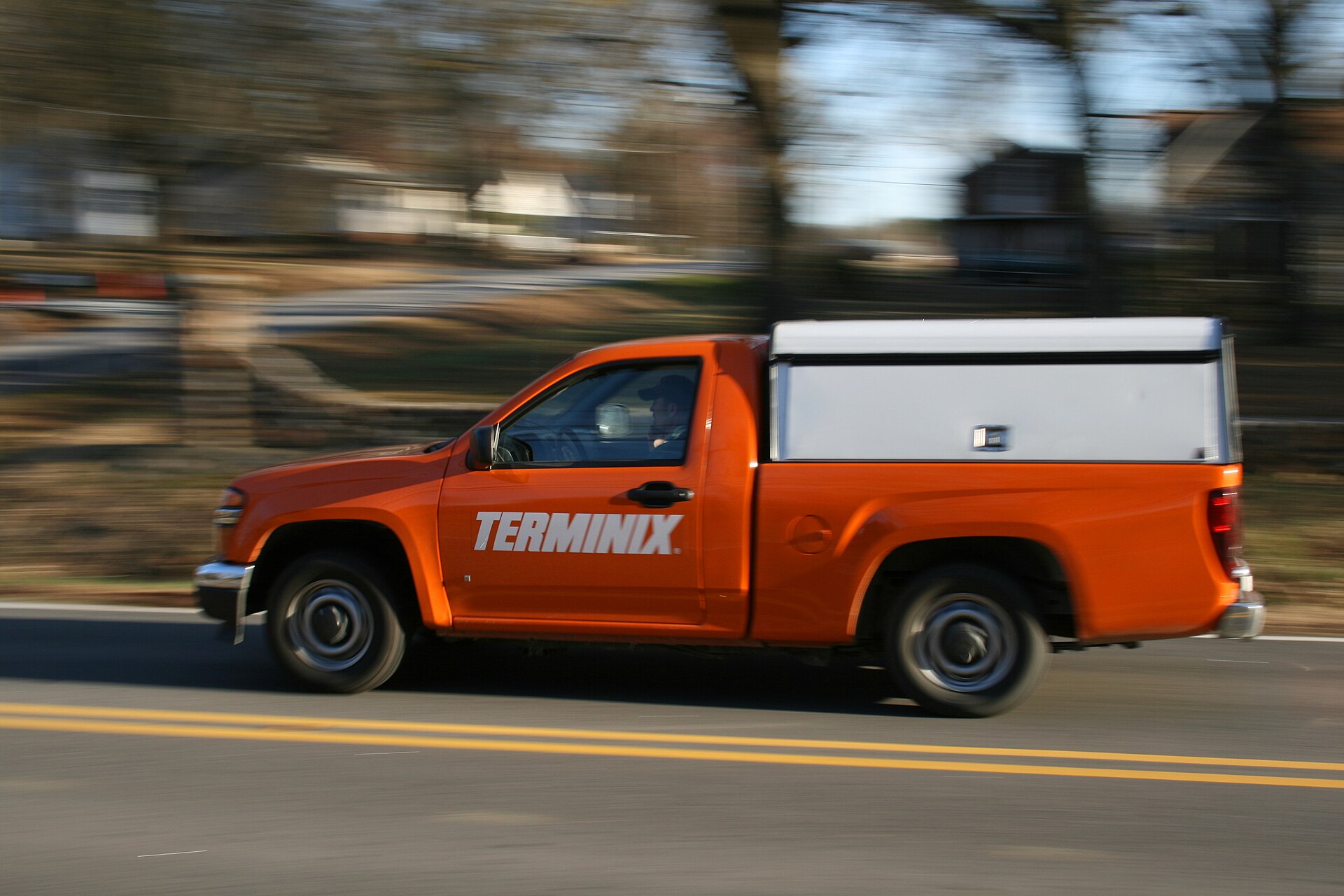
| DATA 1 | Real | Terminix truck photo (licensed) + card "2.9 million customers" |
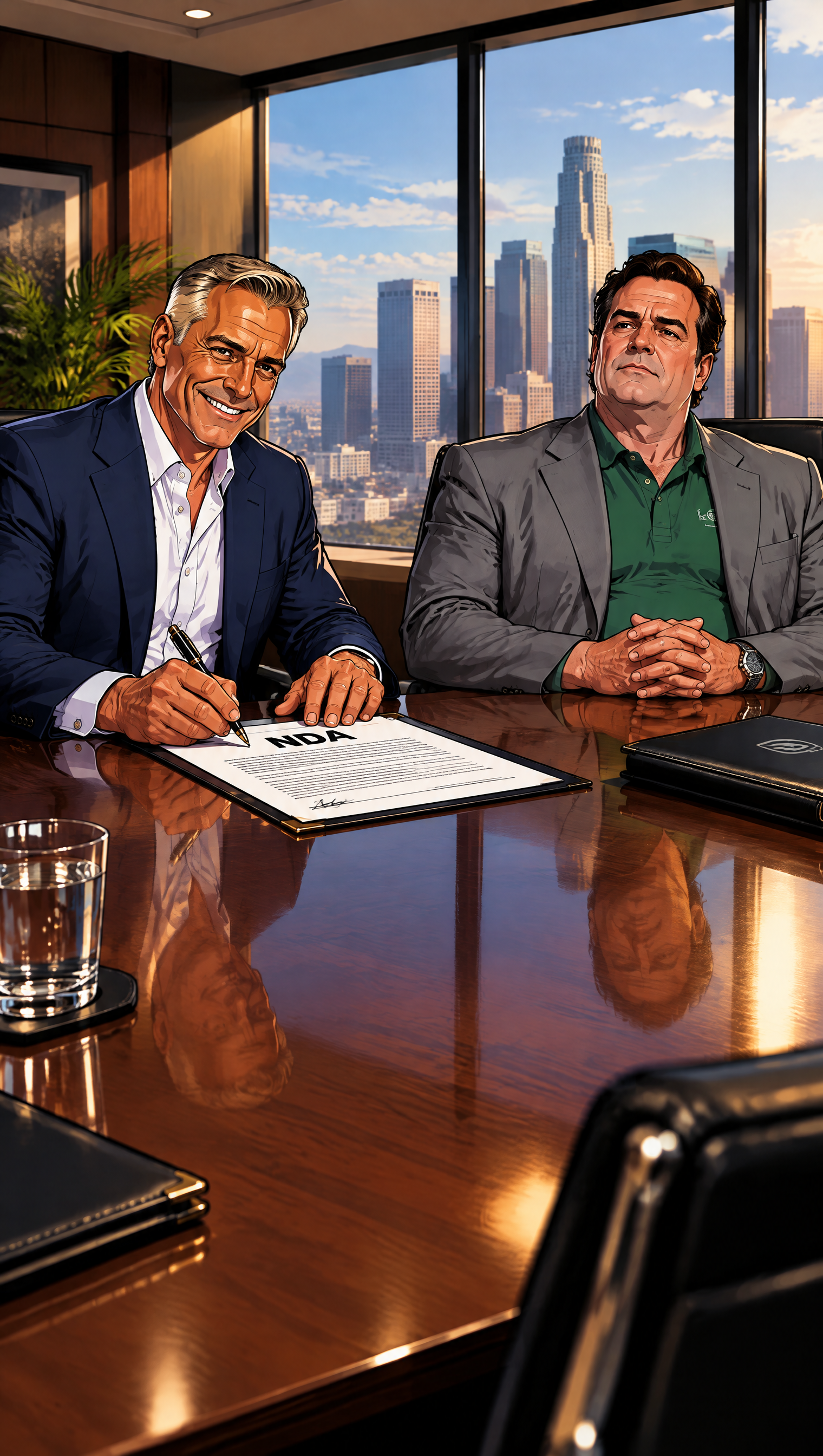
| PIC 4 | Comic | Two teams at a table signing a paper labelled NDA |
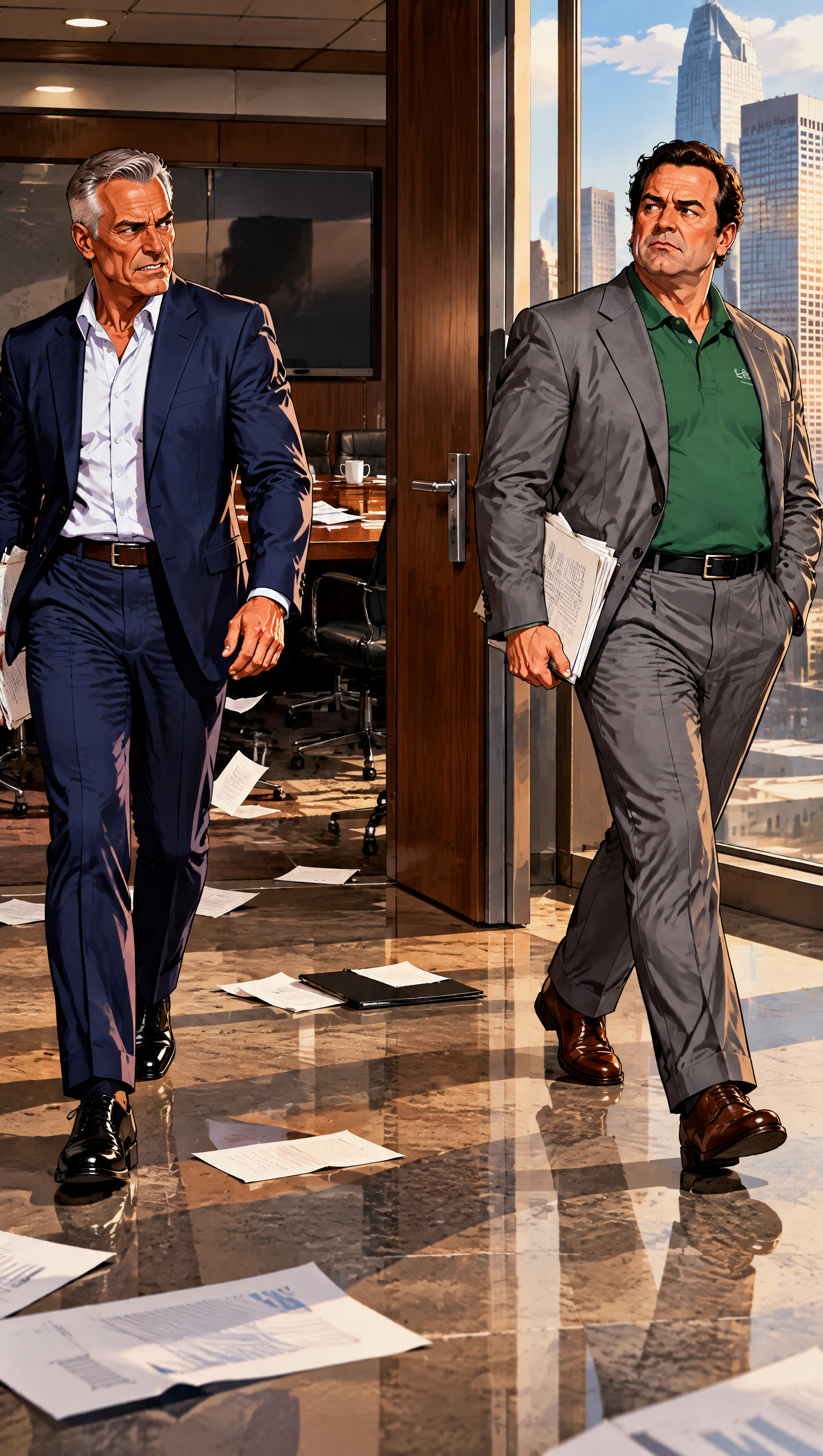
| PIC 5 | Comic | Both teams walking off in opposite directions, papers on the floor. Black card "JUNE 2018" before it |
| PIC 6 | Comic | Terminix boss throwing boxes labelled "HOME WARRANTY" and "CLEANING" off a cliff, keeping one labelled "BUGS" |
| PIC 7 | Comic | Andy on the phone, sly smile. Black card "OCTOBER 1, 2021" |
| PIC 8 | Comic | Banker with a briefcase knocking on 3 doors: "COMPETITOR", "PE FIRM", "PE FIRM" |
| PIC 9 | Comic | Andy at a meeting table, holding up a card "$54". Character small in the bottom-left while Moran explains shares |
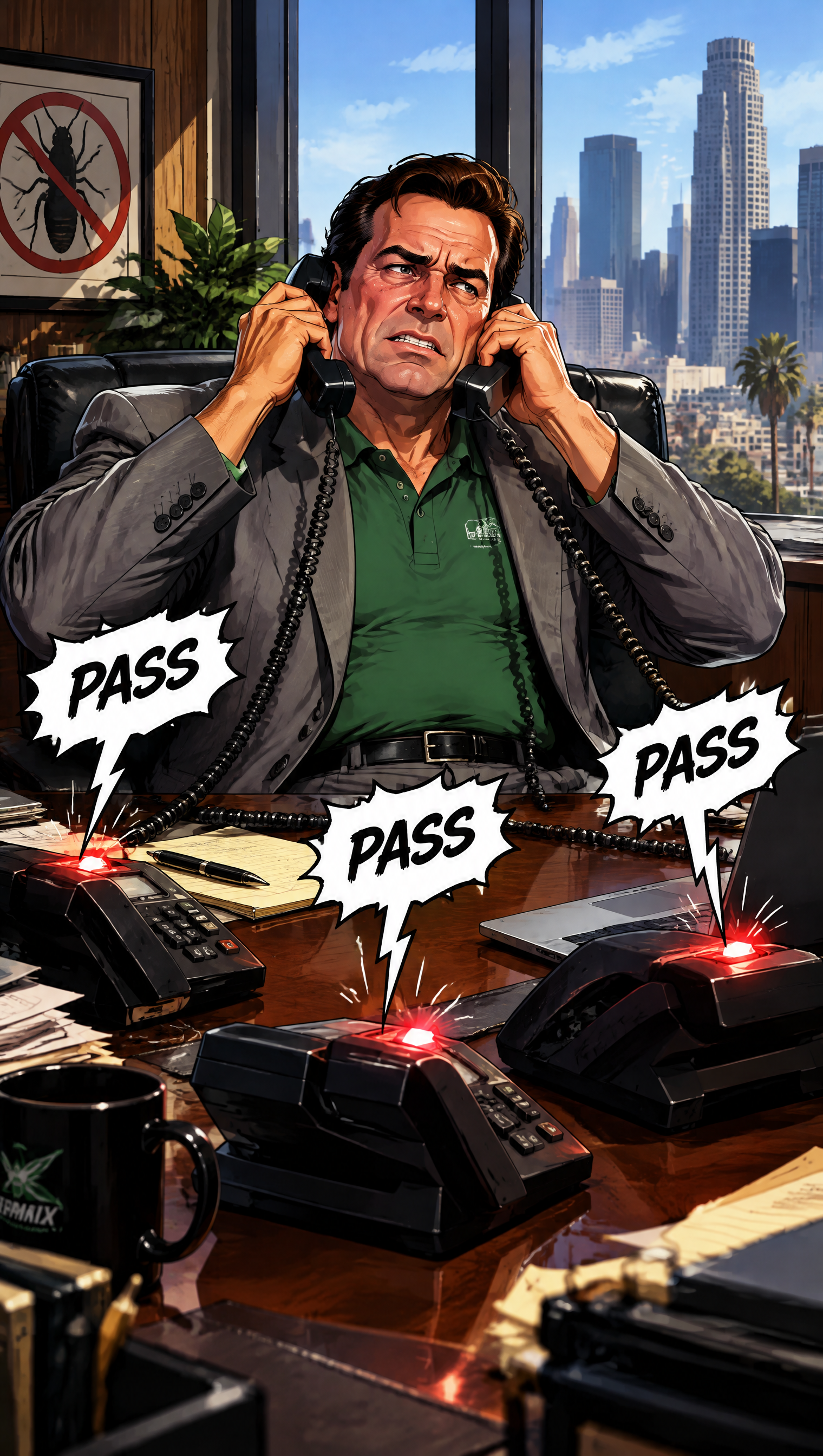
| PIC 10 | Comic | Three phones ringing, each speech bubble saying "PASS" |
| DATA 2 | Real | Terminix stock chart for 2021 with a circle on the $55 high (licensed chart or one we draw from public prices) |
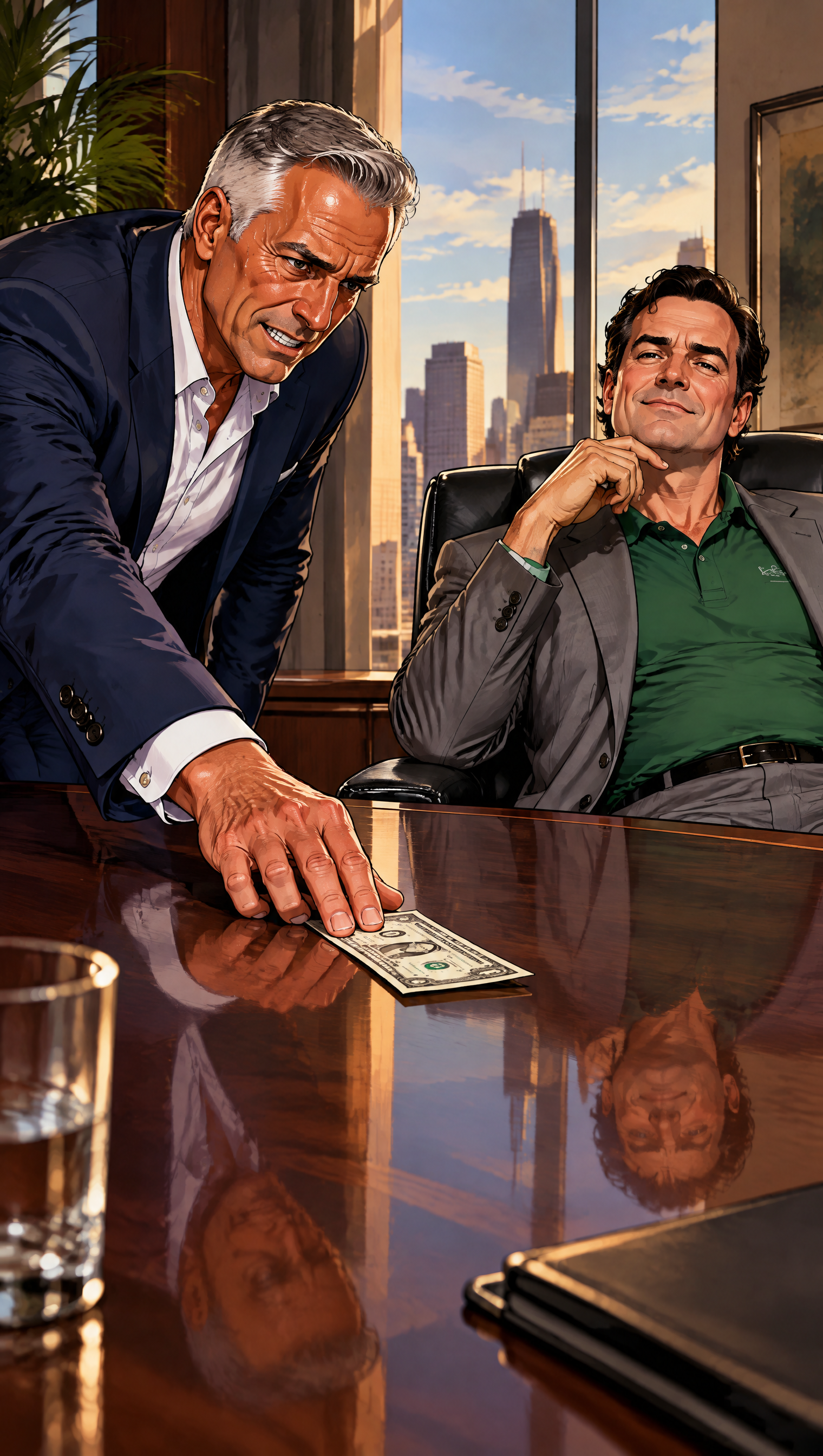
| PIC 11 | Comic | Andy sliding one dollar bill across the table, sweating |
| PIC 12 | Comic | Lawyers tugging a contract in a storm, "HELL OR HIGH WATER" in big letters |
| DATA 3 | Real | Screenshot of the 14 Dec 2021 announcement + green card "$6.7 BILLION" and "+47%" |
| PIC 13 | Comic | Two office buildings merging into one, coins pouring out, "$150M A YEAR" |
| PIC 14 | Comic | Homeowner at the door, confused, a new technician she doesn't know, her dog barking |
| DATA 4 | Real | Rentokil share price chart, Oct 2023 to Sept 2024, with "-20% IN ONE DAY" in red |
| PIC 15 | Comic | Older investor in glasses with binoculars, watching Andy's office from across the street |
| DATA 5 | Real | Licensed wedding photo of Nicola Peltz and Brooklyn Beckham (Getty or AP editorial), caption "April 2022" |
| DATA 6 | Card | "$6.7B ÷ $345M = 19x" then "$6.7B ÷ $495M = 13.5x", tagged MY MATH |
| DATA 7 | Real | Screenshot of the proxy's comparable-deals table + card "36 small companies: $115M" |
| PIC 16 | Comic | A small local pest control shop with a happy owner and the same technician the customer knows |
New in version 3 (the PIC numbers in the script now run 1 to 19; match by the words in each line):
| Moment | Type | What is on screen |
|---|---|---|
| "stuck an R on the front" | Card | "ENTOKIL" with a big red R sliding in front |
| Authority line | Moran + card | Name card "Moran Pober, founder, Acquisitions.com" |
| Lazard's $45 million | Real + card | Filing line on the fee + green "$45,000,000" then "less than 1%" |
| Breakup fees | Card | "$200M if Terminix walks / $150M if Andy's side fails" |
| Golden parachute | Real + card | Filing table row + "$12.9 MILLION" with a cartoon parachute |
| The ladder | Card | Three steps: "36 small companies: under 2x sales", "Clark Pest: 17x profit", "Terminix: 19x+ profit" |
| Who made money | Card | "Terminix holders +47%" in green vs "Rentokil shares about -30%" in red, tagged CHECK DATE |
| AI investors | Card | General Catalyst and Thrive logos (press-kit versions only) + "AI ROLL-UPS" |
| Where AI goes | Card | Savings split: office $108M (highlighted), branches and routes $45M, other $21M |
Moran is on camera for the rest, about 30% of the runtime.
Before recording
| Check | Status |
|---|---|
| Negotiation dates, offers, walk-aways, 12.8% cap, synergy split | From the Terminix proxy (Sept 2022) |
| Price, 47% premium, 80/20, $345M EBITDA, 36 small deals | From the blog's sourced report |
| "About 120 million shares" | Check: $6.7B ÷ $55 gives about 122M, my math |
| "Andy doesn't officially know" | My read, the filing doesn't say. Say so on camera |
| Stock drops, Peltz/Trian board seat | News reports, confirm against Rentokil's own releases |
| Branch plan (600+ to 400 in 2024, about 800 with 220 local by 2026) | Check: the two counts may be measured differently, so the script uses only the 220 |
| "I look at deals for a living" | Your call. Change it if it isn't exactly how you'd describe yourself |
Comic picture prompts (ready to run)
These can't be made yet: the Higgsfield account has 0 credits and no free generations. Each picture costs 0.25 credits on the default model, so these 16 cost 4 credits and a full episode of about 50 costs about 12.5. Once you add credits, I run them as they are.
Style line, added to every prompt: vertical 9:16 comic-book illustration, clean bold ink outlines, flat bright colours, expressive cartoon faces with big emotions, modern webcomic style, simple background, no text unless quoted.
Characters, kept the same in every picture:
- Andy: British CEO in his late 50s, short grey hair, navy suit, white open-collar shirt.
- Terminix boss: American CEO in his 50s, dark hair, grey suit, company polo underneath.
- Banker: sharp young banker in a black suit with a briefcase.
- Peltz: American billionaire investor in his 80s, glasses, white hair, dark suit.
These are made-up looks, not portraits. Before publishing, the editor can match hair and glasses to a licensed reference photo, as the image rules above say.
| # | Prompt (after the style line) |
|---|---|
| PIC 1 | Andy grinning wildly behind a desk while dollar bills fly into the air and cartoon bugs scatter across the floor |
| PIC 2 | A pest control technician by a white van outside a suburban house, rats and roaches running out of the front door in panic |
| PIC 3 | Andy leaning over a giant map of the USA covered in tiny cartoon bugs, eyes wide with hunger |
| PIC 4 | Two business teams across a long table, one man signing a paper that says "NDA" |
| PIC 5 | The two teams walking away in opposite directions, papers on the floor, both annoyed |
| PIC 6 | The Terminix boss throwing boxes labelled "HOME WARRANTY" and "CLEANING" off a cliff, hugging one box labelled "BUGS" |
| PIC 7 | Andy on an office phone, sly smile, one eyebrow raised, a calendar on the wall |
| PIC 8 | The banker knocking on three doors labelled "COMPETITOR", "PE FIRM" and "PE FIRM" |
| PIC 9 | Andy at a meeting table holding up a big card that says "$54", confident |
| PIC 10 | Three desk phones ringing at once, each with a speech bubble that says "PASS", the Terminix boss stressed |
| PIC 11 | Andy sliding one dollar bill across a table, sweating, the Terminix boss smirking |
| PIC 12 | Two lawyers tugging a contract in a thunderstorm with flood water rising, huge words "HELL OR HIGH WATER" |
| PIC 13 | Two office buildings squeezing into one, coins pouring out of the windows, "$150M A YEAR" |
| PIC 14 | A confused homeowner at her front door facing an unfamiliar technician, her dog barking at him |
| PIC 15 | Peltz in a parked car across the street watching an office window through binoculars, calm and smug |
| PIC 16 | A small local pest control shop, a happy owner waving, the same friendly technician the neighbours know |
Real-data pictures already made
From the Terminix SEC filing, vertical 1080 x 1920, ready for the editor:
| File | Use at | Shows |
|---|---|---|
| pic7-andy-calls-the-chairman.png | PIC 7 | Andy contacts the chairman, 1 Oct 2021 |
| pic10-last-buyer-walks.png | PIC 10 | The last private equity firm walks, 18 Nov 2021 |
| data2-52-week-high.png | DATA 2 | Why $54 went to $55: the 52-week high |
| pic12-hell-or-high-water-cap.png | PIC 12 | The 12.8% cap on what Andy must sell |
| data7-comparable-deals.png | DATA 7 | Lazard's comparable deals table, 18.3x average |
Comic pictures, ready to edit (full-screen vertical 9:16, 2K)
Named in script order: pic01 goes with [PIC 1], and so on. Click a picture for the full size. Character sheet (Andy, Terminix boss, banker, Peltz): use it for any new picture so faces stay the same.










Real photos (free to use, credit shown)
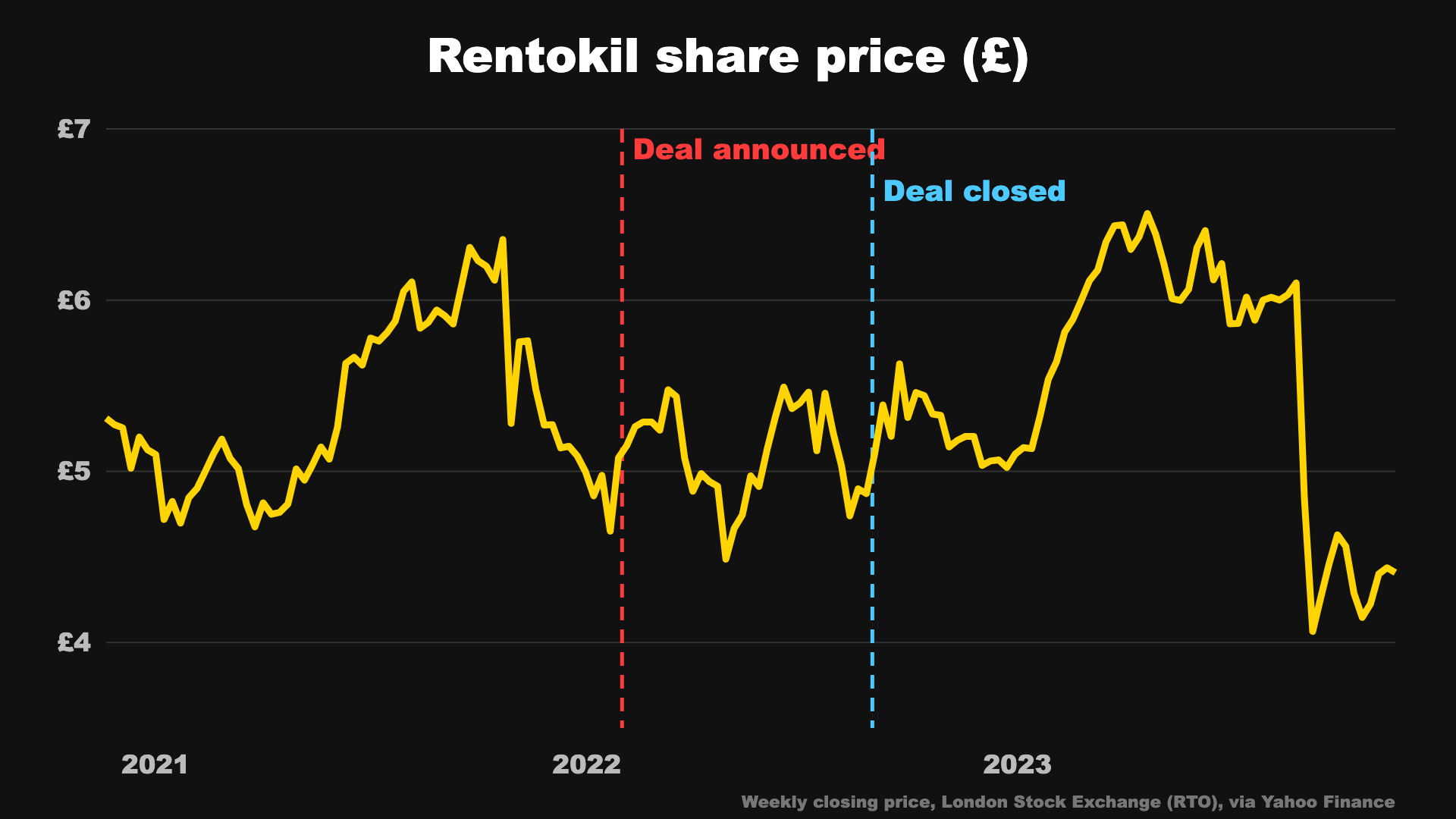

- Rentokil share chart — we made it from public prices. Free to use.
- Brooklyn Beckham and Nicola Peltz, Deauville 2026 — CC BY-SA 4.0, credit: Elyot Boudart / Wikimedia Commons
- Terminix truck — CC BY-SA 4.0, credit: Ildar Sagdejev / Wikimedia Commons
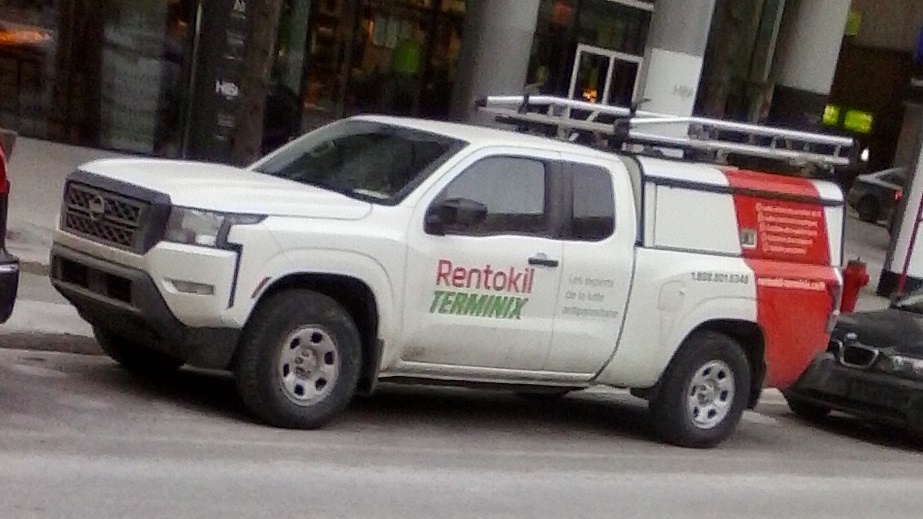
- Rentokil Terminix truck after the deal — public domain
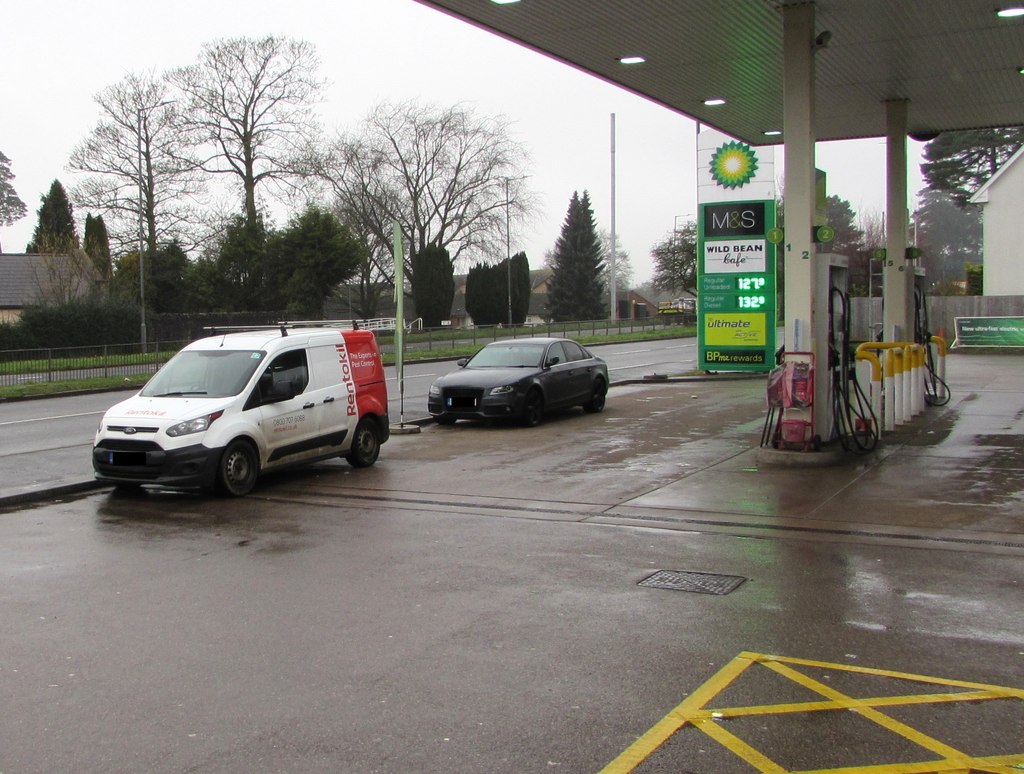
- Rentokil van — CC BY-SA 2.0, credit: Jaggery / geograph.org.uk
Editor: put the credit line on screen, small, bottom corner, while a CC BY-SA photo is showing. No free photo exists of Nelson Peltz alone or of Andy Ransom: use the comic versions, or buy one from Getty Images editorial.
How recent are these deals?
Ray's videos are not acquisitions at all. LifeLock is 2007 to 2016 and ZZZZ Best is the 1980s to 2011. They are only the style to copy.
The Terminix sample is not new: announced 14 December 2021, closed 12 October 2022. I chose it on purpose, because a deal needs years to show what happened after closing.
| Type | How often | Why |
|---|---|---|
| Classic deal, closed 2+ years ago | 3 of 4 weeks | Full story: the filing, the fight and the aftermath |
| This month's deal | 1 of 4 weeks | "Let me tell you about the latest acquisition". The ending is what happens next |
New deals are already on our blog: Affle–Perion (1 Nov 2026), DoorDash–Instacart (29 Oct), Salesforce–Braze (20 Oct). A brand-new deal has no aftermath, and a public target's "Background" section usually arrives weeks later in its proxy, so check before scripting.
Editor brief
Delivery: 1080 x 1920, 30 fps, 8 to 9 minutes. One master file for every platform.
Moran on camera: vertical, chest up, same desk every week, about 30% of the runtime. Keep him on screen for the whiteboard section.
Pictures: about 60% of the runtime. The sample shows at least one change every 15 seconds; aim for a new picture every 8 to 12 seconds, so roughly 40 to 60 per episode.
| Element | How to do it |
|---|---|
| Style | One comic-book style, the same every episode. Never photo-real |
| First appearance | Character picture, name in big white caps, purple arrow pointing at him |
| Same character | Keep clothes and face the same in every picture |
| Year or turn | Black card, white caps, centred: "2018", "HOWEVER" |
| Money | Big green number over the picture: "$6.7 BILLION" |
| Picture-in-picture | Character small in the bottom-left while Moran talks |
| Real proof | Short real clip or filing screenshot, only with rights cleared |
| Progress bar | Burned in along the very bottom, thin, purple on grey |
| Last line | Ends on the dry line. No logo and no pitch |
Two things we do differently from Ray:
- Ray puts invented lines in gold captions ("Todd I'm ruined-"). We only caption real quotes from filings or press. If it is not a real quote, Moran says it in his own voice.
- Each claim carries a small tag where it matters: FILED, MY READ or MY MATH.
Voice and sound
I can't listen to audio, so this comes from measuring 3 of Ray's business videos: loudness, gaps and soundwave pictures.
| What | Ray's numbers | What it means |
|---|---|---|
| Speaking speed | About 162 words a minute (1,453 to 1,469 words in 9:00 to 9:29) | Fast and conversational, never rushed |
| Gaps between sentences | 44 to 101 gaps, about 0.35 seconds each, none over 1 second | Every breath and pause is cut out |
| Silence in the gaps | Dead silent, no room noise | Hard jump cuts between takes |
| Music | None found under his voice | Voice only. The story carries it |
| Loudness | -14 LUFS, range only 3 to 4 LU | YouTube's standard level, squashed so every word is equally loud |
| Sound effects | Few and short, under the big moments, e.g. when "$100 MILLION" pops up | One hit per big reveal, not a soundtrack |
| Real clips | His real TV ads (about 15 seconds in all) play with their own sound | Real proof gets real audio |
The effect types are my guess from the soundwave pictures (a ringing tone under the money number, for example). Watch one with sound to confirm the exact sounds before copying them.
How he talks (from the transcripts):
- Like telling a friend a story: "So", "Now", "And", "But then".
- Dry one-line jokes after a fact: "That actually seems kind of nice."
- He reacts with his face. In the frames: raised eyebrows, wide eyes, the odd eye roll.
- He never sounds like he's reading.
For Moran:
| Do | Why |
|---|---|
| Record in short chunks, one or two sentences each, and redo any you stumble on | The editor cuts the best take of each, as Ray does |
| Talk at about 160 words a minute, like you are telling a friend | The script is written for that speed (9.5 minutes) |
| Make a face on every twist | The face carries the story when the picture is on you |
| Use a clip-on or close mic in a quiet room with soft furniture | Dead-silent gaps only work if the room is quiet |
Editor's sound settings:
| Setting | Value |
|---|---|
| Gaps | Cut every pause over 0.35 seconds and every breath |
| Music | None, matching Ray. If tested, keep it very low and drop it under the whiteboard part |
| Loudness | -14 LUFS integrated, peaks no higher than -1 dBTP, strong compression on the voice |
| Sound effects | Only where the script says [SFX]: about 12 in 10 minutes, short, never over the voice |
| Sound effect source | A licensed library that covers YouTube, Instagram, TikTok and Facebook, e.g. Epidemic Sound. Check the licence before relying on a free YouTube-only library |
| Real clips | Their own sound, only when the clip's rights allow it |
Where to find pictures of the CEO
| Source | Use it for | Rights |
|---|---|---|
| Company newsroom or press kit | Official CEO headshot, logos | Usually for press use. Read the terms and email the press office for a commercial channel |
| Wikimedia Commons | Free photos of well-known executives | Each file has its own licence. Follow it and credit it |
| Getty, AP or Reuters editorial | Real news photos | Paid per image. Check the licence covers YouTube and social |
| Company annual report or SEC filing | Charts, tables, deal documents | US government filings are public, but company photos inside are still theirs |
| CNBC or conference clips | A few seconds of the real person | Owned by the broadcaster. Commentary may be fair use, but that is a legal judgement, so license it or skip it |
Using a photo to make the AI character:
- Use the real photo only as a reference for hair, build and glasses, so the character is recognisable in comic style.
- Never put the real photo on screen unless it is licensed.
- Show only things the record supports: a meeting, a call, a signing. Do not draw a real, named person crying, being arrested or doing anything that did not happen. Ray does this about people already convicted. Our CEOs are mostly not criminals, and a false picture invites a complaint.
- Check each platform's AI label rules before upload, and keep the source of every picture in a simple list.
- Have a lawyer agree the rule before episode 1. Using a real CEO's likeness on a channel that sells services is a bigger risk than on a news channel.
Tool: Higgsfield is already connected, and it can build a character and generate the scenes. Run one test character before pricing an episode.